Cart
0
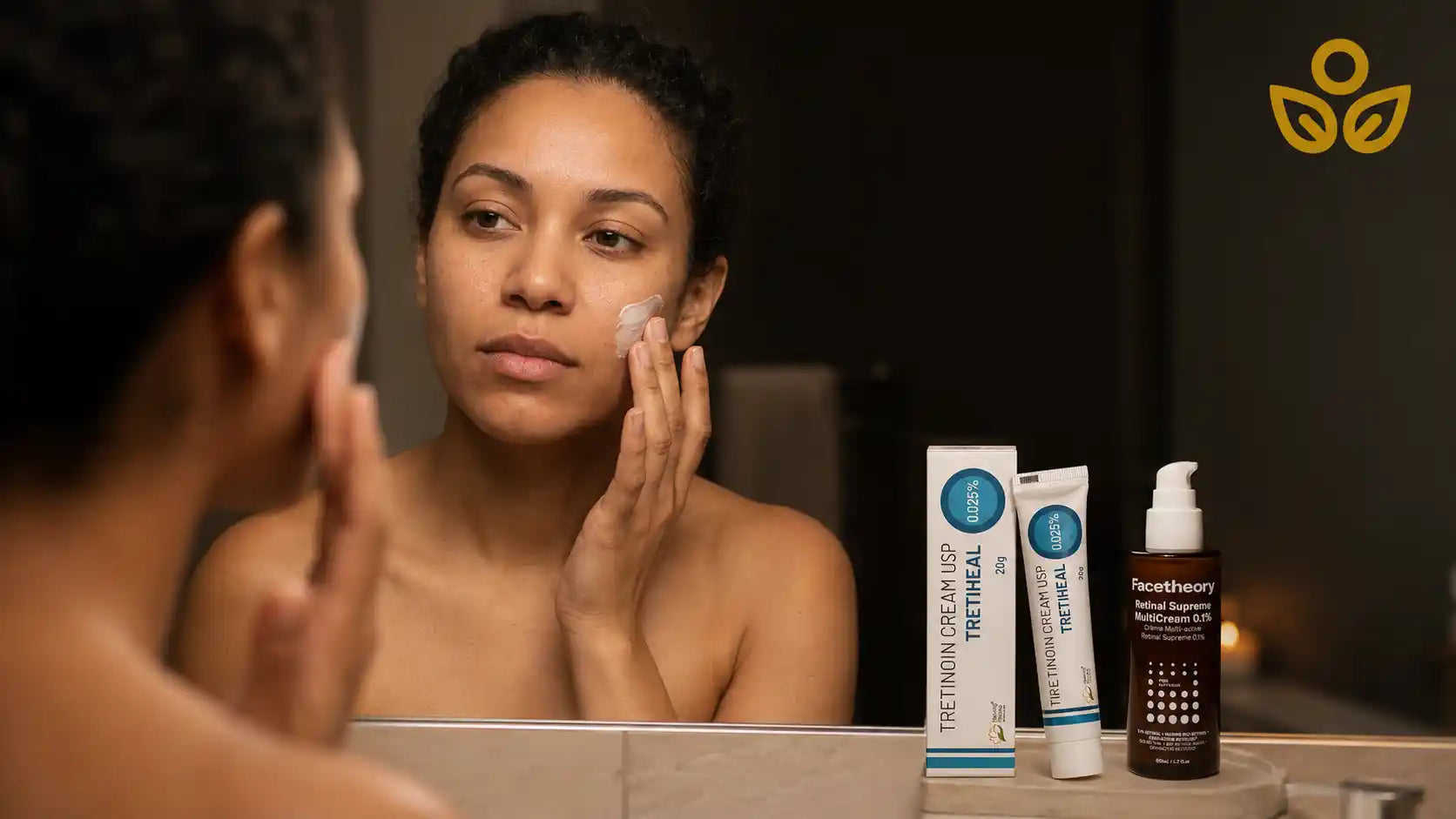
Most comparisons of these two stop at "tretinoin is stronger". That is true and not very useful once you already use actives. The more practical question is where retinal earns a place when tretinoin is already on the table, and when swapping down is the smarter move rather than a compromise.
This guide takes the treatment aware view. Strength equivalence and why the published numbers mislead, how each behaves on pigmentation prone South African skin, using retinal within a tretinoin cream routine, and stepping down without giving back progress.
Where retinal actually sits relative to tretinoin

Retinal is retinaldehyde, one enzymatic conversion away from retinoic acid. Tretinoin is retinoic acid. The gap is a single step, and that step is more efficient than the two step conversion retinol requires. So the retinal behaves far closer to tretinoin than most product marketing suggests, while still being regulated as a cosmetic rather than a prescription medicine. If a lighter vehicle suits your skin, compare the available tretinoin gel options before choosing a percentage.
That regulatory difference matters in South Africa. Tretinoin needs a prescription. Retinal does not. For readers already on tretinoin, retinal becomes the tool you reach for when you need vitamin A activity without the full irritation load. For regulated access and online checks, read where to buy tretinoin in South Africa before purchasing.
The receptor endpoint is identical for both. Once conversion happens, the skin does not distinguish between a molecule that arrived as retinoic acid and one that was converted a moment earlier. Only the amount reaching the receptors differs, and how quickly it gets there. For another topical retinoid comparison, tretinoin vs adapalene covers acne, tolerance, dark marks, and early aging.
Why strength equivalence numbers mislead
You will see figures suggesting retinal is around ten times stronger than retinol, and tretinoin around ten times stronger again than retinal. Those ratios come from concentration comparisons, not from how a formula performs on skin. Vehicle, stability, encapsulation, and pH all shift real world potency considerably. Two products at the same percentage can behave very differently.
Retinaldehyde is also unstable. A poorly formulated retinal degrades before it reaches your skin, which is why some pairs of products at identical percentages produce completely different results. Treat the table below as orientation, not arithmetic. A dedicated tretinoin 0.05% vs 0.1% comparison shows why a higher percentage may increase irritation without improving consistency.
|
|
Retinal 0.05% |
Retinal 0.1% |
Tretinoin 0.025% |
|
|
Conversion needed |
One step |
One step |
None |
None |
|
Rough activity level |
Entry active |
Moderate active |
Moderate to strong |
Strong |
|
Typical settling period |
2 to 4 weeks |
3 to 6 weeks |
4 to 8 weeks |
6 to 10 weeks |
|
Suits melasma prone skin |
Often |
With care |
With care |
Higher risk of irritation |
|
Realistic starting frequency |
3 nights |
2 to 3 nights |
2 nights |
2 nights |
|
Prescription needed in SA |
No |
No |
Yes |
Yes |
The settling periods matter more than the potency column. Cumulative irritation is what derails routines, and it builds over weeks rather than showing up on night one. The Tretinoin Strength Guide compares 0.025%, 0.05%, and 0.1% by concern and tolerance. The same rule applies to separate concerns. The guide to tretinoin strength for flat warts explains why percentage and skin tolerance still need context.
How each behaves on pigmentation prone skin

Both increase cell turnover, which helps pigmented cells move up and out faster. Neither one is a pigmentation treatment on its own. The important difference for deeper skin tones is irritation, because irritation itself triggers more pigment. A gentler active used consistently often outperforms a stronger one that keeps inflaming the skin.
This is the single most useful distinction for South African readers, and most comparison articles skip it entirely. Readers building pigment care can compare skin brightening and hyperpigmentation products by concern instead of treating every mark the same way.
Melasma prone skin
Melasma responds badly to heat, friction, and inflammation. A strong retinoid that leaves skin persistently red can worsen the patches it was meant to help. The melasma vs hyperpigmentation vs sun spots guide helps separate these marks by cause and depth before choosing a routine.
Retinal is often the better fit here, especially during summer. It supports turnover without pushing skin into a constant state of low grade irritation.
Tretinoin still has a role in melasma routines, usually at low strength and low frequency, and usually alongside azelaic acid and rigorous sun protection rather than on its own. Deeper patches move slowly regardless of which retinoid you choose.
Post acne marks
Post inflammatory hyperpigmentation behaves differently. These marks are superficial and respond well to increased turnover, so the faster action of tretinoin has a genuine advantage.
The trade remains the same. If tretinoin leaves your skin inflamed, you generate new marks while clearing old ones. Fresh marks fade in weeks to a couple of months with either active. Older marks take considerably longer. The guide to tretinoin and azelaic acid for acne marks compares turnover, breakouts, redness, pigment, and skin tolerance.
Sun protection decides more of the outcome than the choice between the two. Broad spectrum SPF 50 every morning is not a supporting step in a pigmentation routine, it is the load bearing one.
Using retinal within a tretinoin routine

Retinal is genuinely useful to people already using tretinoin, and it is not a downgrade. It maintains vitamin A activity on nights when tretinoin would be too much, which keeps the routine continuous rather than stop and start. Two applications work particularly well.
Rest night support
Most people on tretinoin do not use it nightly. The off nights are usually blank, which means vitamin A activity dips between applications.
Using retinal on one or two of those nights keeps activity steadier without stacking irritation. Skip it if the skin is already flaking or tender. Rest nights exist for recovery, and filling every one of them defeats the purpose. Do not layer the two on the same night.
There is no additive benefit and irritation rises quickly. For pigment care using two stronger treatments, the tretinoin and hydroquinone night routine covers application order, timing, and irritation control.
Seasonal adjustment
South African summers change what skin tolerates. Heat, sweat, and higher UV all raise the irritation baseline before you apply anything. The guide to tretinoin gel for oily skin explains how a lighter, quick drying base can improve comfort while still requiring barrier care.
Dropping tretinoin frequency and adding retinal on the freed up nights holds the routine together through the hottest months. Reverse it as the weather cools. We found this pattern works better than the common alternative of stopping actives entirely over summer and restarting in autumn, which means repeating the settling phase every year.
Stepping down from tretinoin without losing ground
You keep most of your progress if you replace tretinoin with retinal rather than stopping outright. Skin that has been retained holds much of that adaptation. The change is in pace, not direction. Improvement slows rather than reversing.
Common reasons to step down are pregnancy planning, ongoing irritation that will not settle, a damaged barrier, or wanting a routine that survives a busy period.
The practical move is simple. Stop tretinoin and begin retinal at three or four nights weekly, since your skin already tolerates vitamin A. Most people do not need a fresh introduction phase. Watch for the first two weeks, then build to nightly if it stays comfortable.
Give it two months before judging. The dip people notice in the first few weeks is usually the loss of the mild ongoing flaking that makes skin look smoother, not a real loss of progress.
Pregnancy is the exception where stepping down is not enough. Vitamin A products including over the counter ones are not recommended during pregnancy or breastfeeding. Pause them entirely and discuss alternatives with your doctor.
Where irritation actually comes from in an active routine

If you are running tretinoin alongside other actives, the retinoid is often blamed for irritation it did not cause on its own. Cumulative load is usually the real problem. Several mild irritants together will do more damage than one strong one used sensibly.
The usual culprits in a pigmentation routine: The tretinoin cream side effects guide separates expected dryness and peeling from reactions that mean the routine should pause.
What neither product can do on its own
Neither retinal nor tretinoin will resolve pigmentation without sun protection. Both increase turnover, and both leave newer, more reactive skin at the surface. Without daily broad spectrum SPF 50, that new skin pigments again and you hold steady at best.
They also do not address every cause. Melasma has hormonal and heat driven components that no topical retinoid reaches. Deep dermal pigment responds slowly to anything applied on top of the skin.
A working pigmentation routine usually needs three parts. Something that speeds turnover, something that reduces pigment production such as azelaic acid or a prescribed option, and daily sun protection. Retinal or tretinoin covers the first part well. Neither covers all three. The Hyperpigmentation and Dark Spots Bundle groups turnover, pigment care, and daily SPF into one routine.
Consistency matters more than the strength you choose. Skin that gets a moderate active four nights a week for a year changes more than skin that gets a strong one in bursts. That has been the clearest pattern across everything we reviewed for this article, and it is the point worth carrying into whichever routine you build.
Guidance from tretinoins.co.za on combining actives safely covers the sequencing side in more detail. Anyone considering a high strength formula can review Tretiheal Tretinoin Cream 0.1% before discussing tolerance and frequency with a professional.
FAQs of Tretinoin and Retinal
Can I use retinal and tretinoin in the same routine?
Yes, on different nights. Retinal works well on tretinoin rest nights to keep vitamin A activity steady. Do not layer both on the same night, since irritation rises without extra benefit.
What retinal strength roughly matches tretinoin 0.025%?
No conversion is exact, and formulation affects it as much as percentage. Retinal at 0.1% in a well formulated product sits somewhat below tretinoin 0.025% in activity for most people. Treat it as a guide rather than a swap.
Readers moving from retinal can compare tretinoin 0.025 vs 0.05 before choosing a starting percentage.
Will stepping down from tretinoin to retinal reverse my results?
Progress is generally held rather than lost. Improvement slows, and the surface smoothness from mild ongoing flaking may soften.
Is retinal safer for melasma than tretinoin?
It is often better tolerated, which matters because irritation can worsen melasma. That does not make it more effective. Both need sun protection and usually a pigment reducing active alongside.
Does the retinal need a settling in period if I already use tretinoin?
Usually not a full one. Most people move straight to three or four nights weekly. Watch the first fortnight and reduce skin flakes.
Can retinal be used with azelaic acid?
Many people alternate them on different nights, or use azelaic acid in the morning under sunscreen. Applying both together at night raises the chance of stinging.
Why does my skin look worse in summer on the same routine?
Heat, sweat, and higher UV raise the irritation baseline before any product is applied. Reducing frequency during the hottest months usually works better than pushing through or stopping altogether.
Do I still need SPF if I only use vitamin A at night?
Yes. Increased cell turnover leaves newer skin at the surface that burns and pigments more easily. Daily broad spectrum SPF 50 is what protects the results you are working towards.
Is retinal worth using if I can access tretinoin?
Often yes, as part of the same routine rather than instead of it. It fills rest nights, carries the routine through hot months, and gives you somewhere to step down to without stopping.
Conclusion
Retinal is not a weaker substitute for tretinoin so much as a different setting on the same dial. It fills rest nights, holds a routine together through a South African summer, and gives you a step down that keeps progress rather than pausing it. Pigmentation still needs sun protection and usually a second active alongside either one. Explore related guides on combining actives safely for more routine support. More routine guides and product information are available from tretinoins.co.za.